
Tuesday, April 24, 2012

Need Based Schools vs. Merit Based Schools

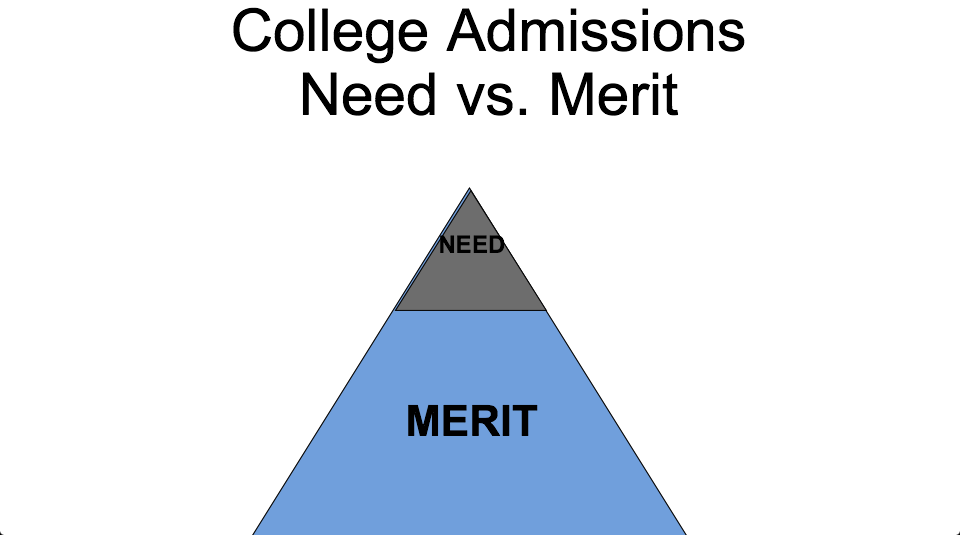
The above picture illustrates the sharp bifurcation in the college admission landscape between schools that provide need-based aid and schools that provide merit-based aid.

Need aid is provided for students who can't afford to pay the price tag.

Merit aid is rewarded to students to help cover the bill.

The former is based on the governing principle that the fewer 0's you have on your W'2, the more 0's the college will tack on to the end of your financial aid package.

The latter is based on the governing principle that the higher the GPA, the higher the test score, the more prolific the involvement, and the more prodigious the leadership, the more 0's taken off the final bill.

Currently there are 74 colleges/universities that offer "no loan" packages.  To see a list of the schools and the qualifications for the "no loan" packages click here.

If you (student) don't qualify for need based on W'2's, you will then have to cover the bill either by paying out of pocket ("EFC" = Expected Family Contribution), paying through a self-help program like work-study, and paying the rest off through the other major self-help program via loans.  Hopefully you will get what you pay for in terms of the school's prestige and the "market value" of a diploma from a "name brand" school.

Some times, for example, our students are shocked when they discover that while OU offers an in-state national merit finalist almost $75,000 in scholarships over 4-years, a school like Northwestern will only give around $12,000, and a school like Georgetown will give $0.

The majority of the 3,000 colleges/universities, however, will reward merit in some way.  Many schools have scholarship tiers.  Denison University, for example, has scholarships ranging from $40,000 a year to $10,000 (click here to see an example of scholarship tiers).

For many of our seniors this year, price tag trumped prestige.  Students and families, in other words, placed a premium in their hierarchy of values based on affordability.  This really isn't "counter cultural".  In fact, more and more studies/articles are showing that students/families are making fiscally conservative decisions on their college choice.  Check out this New York Times article, for example, to see the growing trend.

In the end, we encourage our students to determine with their families what makes the most sense for them.  If best college fit means paying less, then that is the best college fit for that student.   If best college fit means paying more, then that is the best college fit for that student.  One is not "better" than the other.  Best college fit, then, is elastic and flexible enough to include both, as opposed to excluding or elevating one to the other. 

Friday, April 20, 2012

Higly Selective Admissions: The Bucket Down Effect

"What is going on in SMU's admissions?"

It was first question that went off like a cannon ball blast out of this alumni's mouth over the phone.

This particular father was obviously hot over the fact that his son had been deferred in early action to SMU.

And he had reason to be upset. His son had solid, admissible academic credentials. He was captain and leader for all three team sports he played. And he was a legacy applicant.

And yet still he was deferred.

It was at that point that I tried to explain to the father that it is not what is going on in SMU's admission office as much as it is what is coming into SMU's admission office.

I call it the "Bucket Down Effect" in college admissions today.

Here is the illustration I use to explain my theory.


This year, for example, over 28,000 applied to Yale. What's freakishly scary is that the majority of students applying to Ivies like Yale are "admissible" based on academic credentials (GPA, test scores, class rank). Don't believe me, then I would encourage you to read this interview with Maria Laskaris, Dean of Admission at Dartmouth College.

This means that 94% of the bucket, which is filled with "Ivy admissible" kids are being dumped out, and a result, are being forced to go into the next bucket down.

As a result, the buckets just below the Ivies are now getting a higher quality applicant, which then allows these institutions to become more selective.

Vanderbilt
illustrates this.


In just 10 years they have gone from dumping out only half of their bucket of applicants to now dumping out 86% of their buckets - and again most of these kids have "Ivy quality credentials".

Look, for example, at the ACT average for admitted students this year (33-35). That's the same median range for all the Ivies. There is literally no different in the admitted credentials; there is now only a slight difference in the admit-to-deny stats (8% and less -> Ivies; 14% and less -> Vanderbilt's).

So as you can see again from this slide below, those being dumped out of Vanderbilt's bucket are then logically going down into the next bucket below, which in this case is a school like SMU.


This brings me back to what I was trying to explain to this SMU alumni father.

SMU's early bucket was the most credential pool they have ever had.

The average ACT, for example, of admitted students in early action at SMU was a 29.

What's happening then is that we are seeing 1) a proliferation of intellectual and scholarly capital that is making schools below the Ivies so much better, which 2) is making the quality of education (or brand) at these institutions that much better, which then 3) is making the competition for the "supply" of this new quality brand of education that much more intense.

It's very good news for the 60+ colleges and universities that are now admitting 26% and less.

And it is also good news for students getting admitted and matriculating to one of these schools, and many others.

But it is also bad news for those who a few years ago would have been admitted to the SMU's, but now just aren't able to.

Luckily, our student was admitted into SMU during regular admission, along with six other of his peers.

But come next year, we will see the bucket down effect in full effect once again...and the competition for a spot will be that much more intense.

Saturday, April 14, 2012

Recommendations - Writing for Story

On Tuesday I am presenting to colleagues on the topic of recommendation writing.

To view my "Prezi" with the presentation's content see below.


Articles on Highly Selective Admissions

This week I was asked to present before Casady's Board of Visitors on the topic of "Highly Selective College Admissions - Then, Now, and Coming". In preparation for my presentation, I sent our BOV a cadre of links and articles on highly selective admissions.

Below you will find what I sent to the BOV that we pivoted off of in our conversation.

If you wish to read further on this topic:

Thursday, April 5, 2012

College Choice Month: 7 College Buying Tips

It’s crunch time for families in the college selection process. The admission decisions are in and, with less than a month remaining before the May 1 Candidates’ Reply Date, students are now turning their attention to the final choice of a college. It’s an exciting—and nerve-wracking—time to be sure, especially for families trying to reconcile cost and affordability against limited means and/or cash-flow concerns.

If you are in that number, there is a strong likelihood you applied for financial aid and are now trying to interpret the financial aid award letters you received from various colleges. Months ago, as you engaged in the grueling task of completing the financial aid applications, it was the promise of the “just reward” that kept you going. Now that the award letters are in hand, you are left wondering, “what does it all mean?”

To read the rest of Peter Van Buskirk's blog click here.

Tuesday, March 6, 2012

What Colleges Should I Visit over Spring Break?


If you are "spring breaking" somewhere, I would encourage you to check out a range of colleges in that particular area. Here are some recommendations:


Rocky Mountain


Colorado: CU-Boulder and CU-Colorado Springs, Colorado School of Mines, Colorado State U., Fort Lewis College, Mesa State College, Western State College, U. of Denver, Colorado College, Regis University


Pacific Northwest


Washington: U. of Puget Sound, Whitman, Whitworth, Evergreen State, and U of Washington


Oregon: Lewis & Clark, Willamette, Reed, U. of Oregon, and Oregon State


California: Stanford, Santa Clara, U. of San Francisco, Claremont Colleges, Whittier, Occidental, Loyola Marymount, Univ. of San Diego, U. of Southern California, U. of California system (esp. Berkeley, Santa Barbara, LA, & Santa Cruz), St. Mary’s, Redlands.


Southwest

U. of Arizona, Arizona State, U. of Northern Arizona, U. of New Mexico, New Mexico State, College of Santa Fe, St. John’s College


Texas & Louisiana: U. of Texas – Austin, Trinity, Southern Methodist, Rice, Texas Christian, Austin College, Southwester, Loyola, Baylor, Tulane, Xavier (HBCU*), Dillard (HBCU*)


Northern Midwest

Montana: U. of Montana, Montana State

Minnesota: Carleton, Macalester, and St. Olaf

Wisconsin: U. of Wisconsin, Ripon, St. Lawrence University, and Beloit

Michigan: U. of Michigan, Michigan State, Hope, Kalamazoo


Midwest

Illinois: U. of Chicago, Northwestern, Lake Forest, Knox, Loyola, U of Illinois (Champagne)

Iowa: Cornell College, Grinnell, and Coe College

Nebraska: Creighton University, University of Nebraska

Ohio: Kenyon, Oberlin, Denison, Wittenberg, Xavier, Ohio Wesleyan, College of Wooster, Miami (Oxford), Hiram, Case Western

Indiana: Indiana U., Notre Dame, DePauw, Earlham, Butler, and U of Evansville

Missouri: Washington U., St. Louis U., U. of Missouri – Columbia, Westminster, William and Jewell

Kansas: U. of Kansas, Kansas State, Southwestern, University of Kansas City-Missouri


Mid-Atlantic:

Pennsylvania: Bucknell U., Franklin and Marshall, Dickinson, Gettysburg, Bryn Mawr (women), Haverford, Villanova, Lafayette, Lehigh, Carnegie Mellon, U. of Pennsylvania, Allegheny, Drexel

New York: Colgate, Hamilton, Hobart & William Smith, Cornell, Rochester, Ithaca College, Union, Skidmore, Vassar, Sarah Lawrence, New York U., Columbia, Fordham, Bard, Barnard (women), City College

New Jersey: Princeton, Drew

Maryland: Johns Hopkins, Washington College, Goucher , and U of Maryland

Washington, DC: Georgetown, George Washington, American, Howard (HBCU*)


Northern New England

New Hampshire: Dartmouth, U. of New Hampshire, Keene State College, Colby Sawyer College

Vermont: U. of Vermont, Middlebury

Maine: Colby, Bates, Bowdoin


Southern New England


Boston Area: Boston College, Boston U., Tufts, Brandeis, Babson, Bentley, Emerson, Simmons (women), Harvard, Massachusetts Institute of Technology, Wheaton, Wellesley (women), Northeastern

Western Massachusetts: Amherst, Hampshire, Williams, Smith (women), Clark, Holy Cross, Worcester Polytechnic

Connecticut: Trinity, Yale, Connecticut College, Fairfield University, U. Conn

Rhode Island: Brown, Rhode Island School of Design, Salve Regina, Roger Williams, U. of Rhode Island, Providence College, Bryant.


Southeast

Alabama: Auburn University, Alabama, Samford

Georgia: Emory, Spelman (HBCU*, women), Morehouse (HBCU*, men), Georgia Tech, UGA

Kentucky: Centre College

Tennessee: Vanderbilt, Belmont, U. of the South (Sewanee), Rhodes, U. of Tennessee

North Carolina: UNC-Chapel Hill, Duke, Wake Forest, Davidson, Guilford, Elon, UNC-Asheville

South Carolina: College of Charleston, U. of South Carolina, Furman, Wofford, Clemson, Presbyterian.

Virginia: U. of Virginia, Richmond, Roanoke, Lynchburg, Hampden-Sydney (men), Randolph, Washington & Lee, William & Mary, Mary Washington, Hampton (HBCU*), Virginia Tech, Shenandoah

Florida: U. of Miami, Rollins, Eckerd, Flagler , U. of Florida, Florida State

*HBCU= Historically Black Colleges and Universities

Monday, March 5, 2012

Should I Take AP Bio or Honors Forensics?

Every year at this time I get a staccato of questions from students and parents about academic course programming.

Should I take AP Bio and risk getting a B?


Or should I take Honors Forensics and get the easy A?


And will colleges really know how hard AP Bio is compared to Honors Forensics?


And what about electives?

Is it okay if I substitute out a Spanish 5 and take something like AP Art History or Music Theory?


These are all excellent questions.
And my answer is always the same. It all depends. It all depends upon what kind of colleges and universities you plan on applying to.

This is where I often point to the "pyramid of selectivity".


Most Highly Selective (1/8)

Highly Selective (1/4)

Selective (1/2)

Somewhat Selective (6/8)

If you plan to apply to colleges that admit 6/8, then taking the "easier" core class probably won't be a big deal when you factor in everything else - rest of academic program + performance, extracurricular activities, essays, teacher/counselor recommendations, possible interview. But once you start thinking about selective institutions that admit 1/2 like a SMU or a USC that admits 1/4, and on up the pyramid to the schools that admit 1/8 to 1/10 like Duke, Vandy, and the Ivies, then you really have to re-think your strategy.

At Casady, we counsel our students to take the following measures when it comes to course selection:

  • Aim for 5 core classes (math, science, English, humanities, and language)
  • Try to move to the next level of rigor in at least four core classes (all five if possible).
  • Plan for a 4th year and/or 5th year of language studies (if recommended by faculty), especially if you plan to apply to schools admitting 1/4 to 1/10.
  • "Doubling up" in one core subject is not recommended until the senior year.
  • Preserve the senior year for substituting out a class you don't want to take for substituting in a class you do want to take.
  • And avoid the senior year "myth trap": your senior year grades do matter. Many colleges, especially selective schools, will call for current grades days before they go to committee.

In the end, I always counselor students (and parents) to strive to take the most challenging curriculum they can handle, and then do the best they can in that curriculum. The challenge in "identifying the right amount of challenge" is that it is never an exact science. It's often a communal act of discernment among many parties - student, parent, coaches, counselor, club sponsors, etc. What's best academic programming wise for one student then may not be the best course of action for another student.